The majority of ELM Group electricity and gas contracts are due to expire on 30 September 2026 and over the course of the last few months we carried out the work, under the guidance of our Energy Consultant, Bespoke Utilities, to arrange new contracts. As you will no doubt be aware the conflict in the Middle East and the disruption to the Strait of Hormuz has had a significant impact on global gas supplies and therefore energy prices as a whole.
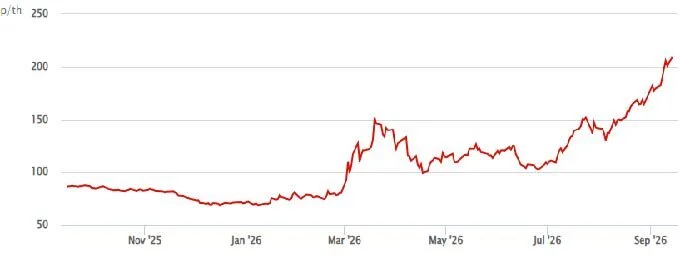
The graph below indicates how commodity prices are being impacted by the situation Middle East which started back in March:
The ELM group energy portfolio consists of 306 electricity supplies and 24 gas supplies. Energy for consumption in the communal areas / common parts of our estates will be classified as a ‘landlord supply’ and therefore subject to commercial or business terms. The contracting entity is a business (whether that’s a freeholder, managing agent, resident management or right-to-manage company) and not comparable with any domestic rates and/or any publicised domestic energy price caps, although the VAT element is reduced to 5% to reflect a supply to a qualifying residential property. Domestic customers are protected by the energy price cap however it’s not the same for business customers - there is no equivalent price cap and costs move with the market, so it's arguably even more important to fix contract rates and avoid variable or deemed out-of-contract rates.
Our process
As in previous years we took the decision to focus on the much larger electricity portfolio initially, with the gas contracts to follow immediately after. Energy suppliers will provide contract rates on a specific date with offers only valid until 4pm on the same day. Therefore, ELM conducts an initial exercise to review the market and identify the most competitive supplier within the current market conditions, with a view to refreshing prices and locking into contracts within the next 14 days. During the 14-day period (and where applicable) we share our plans, market conditions and prices for the relevant supplies with any Clients (ie freeholders, resident management companies, right-to-manage companies) providing an opportunity to opt-out of the ELM Group negotiations if deemed appropriate. We are confident our approach to energy procurement is therefore both ethical and transparent.
Background Information
Within the industry, Bespoke has advised that property management clients are viewed as higher risk and therefore not all suppliers will be willing to undertake a portfolio of our size. On this occasion Bespoke approached SSE, EDF, Utilita, Corona, British Gas, Total, EON, Crown, Ecotricity & United Gas & Power and on each occasion the current supplier (EDF for electricity & Crown for gas) continued to offer the most competitive rates.
Each supply (gas and electric) is priced individually based on its own technical specification, configuration and network registration. Any charges (including government levies) applied to the meter classification are specific to that supply and are not influenced by the costs, usage or tariff arrangements of any other ELM managed estates. Whilst portfolio procurement allows us to access the market through a managed tender process, the underlying network and metering charges applicable to each individual supply remain unique to each estate.
Standing Charges
OFGEM has changed the way that energy is priced with certain meters absorbing more of the cost for the maintenance of the network. What is noticeable at this renewal is how the change in pricing has resulted in higher standing charges and lower unit costs as suppliers are apportioning more non-commodity costs through the standing charge (as a fixed cost to guarantee the money needed to pay for the network). These additional charges have been in place for some time, but when non-commodity costs increase, it is noticed on the standing charges more than the unit rates. And the increase in standing charges in general, means that low consuming estates (or supplies) will notice a more significant percentage increase than those with higher consumption.
Electricity Renewal
Everything went to plan and within the agreed timeframe we were able to obtain indicative costs and then agree to contracts on 13 July, where the refreshed prices had only slightly changed from those originally obtained. The overall price increase across the entire portfolio was 2.35% for the next 12-month period, although the rates vary from estate-to-estate (between the regions of -29% to +26.8%). Due to the volatile nature of the energy markets the advice was to contract for just 12 months on this occasion.
Gas Renewal
Our plans, and the process ultimately adopted for the gas renewal, was not quite so straightforward and our decisions were negatively impacted by the continually changing situation in the Middle East. As follows:
13 July – initial market approach identified increase in costs at 6.83% for the group portfolio. The plan was to refresh in 14 days and arrange contracts for the next 12 months
29 July – refreshed prices were significantly higher than the initial market approach @ 23.5% uplift. US intercepted an Iranian attack on a military base with the result that the market spiked upwards. Europe gas storages at 56% whereas it’s usually around 72% on average at this time of year so causing concerns ahead of the winter period. Agreed to monitor on a week-by-week basis
05 August - prices came down 3% since previous week, so at a 20% increase. Prices dropped 3 days in a row but not enough to counteract the increases from the last month but heading in the right direction. There were some expectations that the Strait of Hormuz would reopen soon which would help with global supply and to drive prices down.
11 August - prices increasing this week. This was due to potential peace talks stalling and uncertainty increasing. 20% of the global LNG flows are impacted by the Strait of Hormuz being closed so this was causing the market disruptions
19 August - European gas prices remained near three-week highs as prospects for normal shipping through the Strait of Hormuz weakened following President Trump's comments that no talks are underway with Iran
26 August - prices dropped a little bit but not enough to counter the increases since we last priced
11 September - prices increasing as there were tanker strikes between the US and Iran over the weekend. One fifth of the global supply is currently trapped in the strait of Hormuz
7 September - tanker strikes between the US and Iran caused further increases
14 September – situation continuing to escalate, with no signs for improvement, ELM advised to act immediately.
In July we were anticipating that the markets would improve as it’s not unusual for some peaks and troughs. When it was apparent improvement didn’t seem likely prior to our renewals, we considered a couple of alternative options ie taking no action and leaving the gas supplies on out-of-contract (variable) rates until the situation improved or only agreeing to a 6-month short-term contract. Ultimately it was considered both options would come at an even higher cost to the estates. With winter approaching, further price rises will be inevitable when the already depleted gas storage levels have to cope with higher demand due to the colder weather. And, as we have already mentioned, without a commercial price cap the out-of-contract rates can be increased on a monthly basis. So even though the costs had increased substantially we reluctantly agreed to a 12-month contract with an overall price increase across the entire portfolio at 51% (with rates varying per supply between the regions of 31% - 91%).
In conclusion
We appreciate increases in costs are never going to be welcome. The situation we’re facing is unprecedented and it’s difficult to predict how markets will react. Bespoke will continue to monitor the markets and offer their insight into when next year’s renewal should be considered.
We would also like to take this opportunity to reassure you that ELM does not, and never will, accept any sort of commission. Bespoke Utilities recovers their commission directly from the energy providers and Bespoke is committed to being entirely transparent in their fee structure and commission arrangement with us and any chosen energy provider. They have over 15 years’ experience in working within the property management sector and direct relationships with all major commercial energy providers. They’re also included within The Property Institute (TPI) Partnered Directory for their work carried out in the sector.
Your Area Manager and Estate Manager (where applicable) have been advised of the contract costs for your specific estate and can provide you with full information and further breakdown if required. Alternatively, please feel free to reach out to me directly if you have any further queries or would like any additional (or broader technical) information from Bespoke Utilities.
Gill Birch, Business Co-ordinator
